Showing posts with label North America. Show all posts

Sunday, July 11, 2021

Butterflies and Other Backyard Finds

Face on with the swallow tail.
 I was with my family hanging out in the backyard and we spotted a couple butterflies on the cone flowers of my aunt's garden.  Having worked in a butterfly garden or two in the past they were easy to identify. The larger butterfly with yellow wings that have black stripes is called a tiger swallowtail. The white one is just a white butterfly, there are many types but it was hard to identify it when it kept moving about. As I got closer to take the pictures of the butterflies the swallow tail would fly away then swoop around the yard before returning to the flowers. To help identify some butterflies in Maryland you can go to: http://www.marylandbutterflies.com/, or for general North American moths and butterflies see  https://www.butterfliesandmoths.org/. These are both good places to start when trying to identify butterflies. To attract butterflies there are two different kinds of gardens one can make, for them to lay eggs on called host plants and one for nectar. Some butterflies only lay eggs on certain plants for the larvae, caterpillars, to eat and grow on. Monarchs for example only lay eggs on milkweed because that is what they eat. My aunt's garden has more of the nectar plants. These are good for the adult butterflies to enjoy some nectar for food.

There was also a squirrel that made an appearance trying to get food from the bird feeder. Which sometimes happens. And a few birds flew by as well.

What is in your backyard? Try making garden choices that are good for wildlife which make for great nature watching. Pollinators like butterflies need more flowers to enjoy, and we get to enjoy looking at them. Meet Me Outdoors.

Monday, August 21, 2017

Did You See the Solar Eclipse 2017?

Today millions of people across the United States watched the solar eclipse. Some were lucky to be in the totality, most were in areas where you only can see a partial eclipse. I was in Baltimore, MD at the Maryland Science Center. While we did have to wait for clouds near the maximum eclipse, we still got a good views when we did. 

Solar Eclipse 2017 Through the Clouds in Baltimore, MD
I was able to capture the partially eclipsed sun through the clouds that were just the right thickness. What did you see during the eclipse? Did you try any of the safe viewing tricks

Save those eclipse shades for the next solar eclipse that will cross through the United States in 2024. The path of totality will go from Texas to Maine crossing through Cleveland, Ohio. Where will you be for the next eclipse? Looking forward to next time, Meet Me Outdoors.

Tuesday, August 15, 2017

Safe Solar Viewing of Solar Eclipse 2017

The most talked about celestial event of the year is less than a week a way. On August 21, 2017 the Moon passes in between the Earth and the Sun and this shadow is going to move across the Continental United States from Oregon to South Carolina. This is called a solar eclipse.

Only people in the path of the shadow will see an eclipse.

Everywhere not in the center of this path but in North America will be getting a partial eclipse while those on the path are going to see a total eclipse of the sun. Where will you be during the solar eclipse of 2017? Check out NASA's Eclipse 2017 website for an interactive map and see how much of an eclipse you will get.  Here is a collection of tips for viewing this really cool event with your friends and family.

Rule #1 - NEVER LOOK DIRECTLY AT THE SUN

Taken with cellphone camera with eclipse shades used as solar filter
The sun is way to bright to look at with your own eyes. Staring at the sun can burn your eyes damaging them and rendering you blind. When any part of the sun's surface is visible it is still dangerous to look at without protection. The only way to safely look at the sun directly is to use solar eclipse shades. To know if you have the correct, safe shades you need to see that they have ISO 12312-2 international standard certification printed on them. The only thing you should be able to see with these specially rated eclipse shades is the sun. (See picture of sun with filter.) Your regular, everyday sunglasses are not rated for direct solar viewing, DO NOT use them for the eclipse. 
Science museums, planetariums, observatories even some libraries have been giving away the safe solar eclipse shades however supplies is limited as the eclipse day approaches. Finding these shades online for purchase is not cheap. If you haven't gotten a pair of these eclipse shades, fear not! There are ways to experience the eclipse without going blind. 

Shadow Play - Eclipse Style

In doing research for this blog post, and for work, I have found some unique tricks to viewing the eclipse indirectly.

Pinhole Projector 

A pinhole projector is made using, as it says a pinhole to project an image of the sun. Take two cards card and poke a hole in one of them. Take both cards outside with you during the eclipse and stand with the sun to your back. Hold the card with the hole in it over your shoulder and the other card just a few inches away. If aimed right you should see a bright dot on the second card, this is the sun. You can move the second card away from the pinhole card to get a bigger projection. Making the hole bigger means you will have to move the card farther from the card or paper you are projecting to. Don't try to see the sun through the hole, this will blind you, always look at the shadow of the card.

Want to have some fun with your pinhole projections? 

Pinhole projection of a solar eclipse using a colander. Credit: Alice Pintus
Try poking out a message in your card. During the eclipse you will see crescent suns projected in the shape of your message.  Bring out some simple kitchen items like a spoon with holes, colander (the kind with big holes works better than mesh) and a grater with small holes. Aim these objects while looking at the shadows on the ground and when you get it to show the holes you will see little projections of the sun. Pinhole projection ideas.

Make a pinhole viewer tube

To simplify your pinhole projection during eclipse time make a pinhole view tube like the one shown here.  All you need is a cardboard tube like a mailing tube, you can even use a potato chip tube if you have one, thick index card and tape.  See instructions below, adult assistance required to cut through cardboard tube.

Pinhole viewer tube window with end capped off (Steps 1 and 2)
Step 1 - Cut a rectangle out of one end of the side of the tube to make a window. (See picture.)
Step 2 - Cap off the end of the tube with the window with white paper. (See picture.)
Step 2 - Tape a thick card or tinfoil to the opposite end of the tube from the window. 
Step 3 - Poke hole in the card taped on the end opposite from the window. 
If you are using a potato chip tub - Step 4 -  roll and stick dark paper inside inside the canister to reduce any brightness from foiled walls of the tub.  Re-cut the window out of the dark paper to see the white paper at the bottom.

Completed pinhole viewer tube
Pinhole on top -  Window and capped end on bottom
Once made take outside on sunny day have sun behind you and tip tube so that the end with the pinhole is pointing toward the sun and the window down to the ground. See picture of completed viewer tube to see how to hold it. To aim it right look at the shadow of the tube on the ground and tip the tube so the shadow looks like a circle and not a hotdog. When the shadow is a circle you can look through the window down to the paper and you should see a projected sun on the capped end inside the tube. During the partial eclipse phase you will see a crescent sun on the capped end at the bottom through the window when aimed correctly. The longer the tube you have, the bigger the projection will be. With the potato chip tubs the image will be small and slightly out of focus. A longer tube will be a bit more in focus and you can get a larger projected image of the sun. The bigger the pinhole the farther the screen needs to be to get it in focus. Interesting note - with the pinhole projection the image seen is upside-down.

Tree Shadows

Do you have a tree nearby? One really cool way to see the partial eclipse phases is to look at the shadow of the tree. In this shadow the tiny gaps between the leaves are acting as a pinhole projector and you will see crescent suns in the shadows.  As long as you don't break Rule #1 and look up through the tree to the sun, this is a safe fun way to see a projection of the sun being covered by the moon.
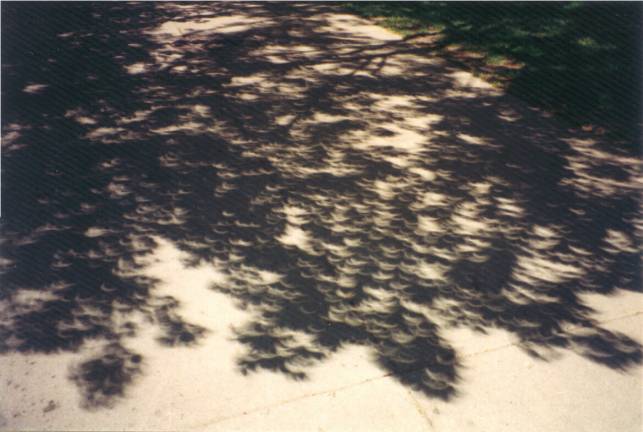
https://apod.nasa.gov/apod/image/0012/eclipsetree_ejisrael_big.jpg
The Eclipse Tree - Credit & Copyright: E. Israel

Things to Remember

If you happen to be in the path of totality and the crescent sun in the shadow has disappeared, you can actually look up at the sun directly and witness the total eclipse of the sun. The sky will darken, you may feel it be a bit colder temperature, and you may notice animals behaving like it is almost night time. Of course, once the Moon is no longer blocking the full sun you need to look away, put those eclipse shades back on if you got them, and celebrate that you saw a total solar eclipse. 

For the rest of us not in the path of totality, but able to see a partial solar eclipse stick to the safe viewing tips mentioned above, my personal favorite that I will try is the colander projection method. Also remember, while the eclipse is a special event, being out in the sun is no different from any normal sunny day. Wear your sunblock, bring a hat, drink water to stay hydrated. With kids you can use these safe viewing methods of shadow play and have a good time. Whether go to a special eclipse viewing event or make one of your own, join millions of people across North America and experience the Solar Eclipse of 2017, Meet Me Outdoors.


For further information and other resources:
NASA's eclipse website, has lots of good resources - eclipse2017.nasa.gov  
Extreme detailed dos and don'ts of eclipse: https://dyer.vanderbilt.edu/solar-eclipse/ 
Video: Why a total solar eclipse is such a big deal - https://youtu.be/oNH3akWXaV8

Friday, June 9, 2017

Exploring the Rain Garden

A few years ago I ran an elective class that helped maintain a garden across the field from the school. It has likely been as long since anyone really looked over it. The garden was designed to act as a rain garden and a learning garden. As a rain garden the plants are native to the region and everything grows without much maintenance. When I ran the elective I tried to have a section or two of the garden for a vegetable garden for the kids to maintain. With no one maintaining it over summer between school years the vegetable garden patches are lost among the rest of the plants. What brought me to the garden this time was that it was the end of the school year and I wanted to add my class's compost collection to the compost pile.
The path I usually take to walk through the garden was over grown when I arrived the other day. The alternated path took me over the water that runs through the garden. If you look carefully in the first picture you can see the bit of purple flowers that caught my eye.  You can see it the little dip in the garden that is where the water collects when it rains. I wouldn't say it is big enough to be called a creek, but it is enough that you have to hop over it to get the back main part of the garden. 

The plants may not seem like much from the distance, many are about waist height on me. I don't think I would let the younger kids I work with run through it now since most of the plants would be taller than them and I would lose sight of them. 

Along the edges of the garden, especially near the dip in the ground, I could see some interesting flowers of different colors. The one I could identify was that purple flower, you can see my attempt to take close ups of the flower with my phone on the left. The flower is a type of iris. I like the colorfulness of it. It is days like that one when I walk through the garden when I miss having one.  Right now all of my attempts to plant things from seeds has only given me sprouts but no plants from that. My geranium is the only plant that I have had for a few years that is still growing nicely, hopefully it will flower again soon.  While I may not have my own garden it is nice to be able to see other ones near by. Hope you also get to see what your neighborhood gardens have to offer this spring, Meet Me Outdoors.

Tuesday, August 16, 2016

Lake of the Isles Park - Minneapolis, MN

Beginning of this year's summer road trip traveling along the Mississippi River starts in Minneapolis, MN. Minnesota is known as the land of 10,000 lakes so I walked around Lake of the Isles Park which is part of Minneapolis Chain of Lakes Regional Park

It was a really nice walk even as it reached midday summer heat. I made sure to bring hat, sunglasses, sunscreen, and took water, which is important.


Between the walking path and the lake was perimeter of wild flowers where I saw some butterflies fluttering from flower to flower and other pollinators like bees. I saw some monarch butterflies and an Eastern tiger swallowtail butterfly. Only the one that I was able to take a picture of was a monarch. Look for the triangular shaped thing in the center of the picture.

As I walked around the lake there were some rent a canoe spots and we watched as one group prepared themselves to start their canoeing experience.  There are two paths around the lake, one for those on foot and the other for those who are on bikes. The lake I walked had a very funny shape to it unlike another in the chain of lakes that is more circular.  The shape of Lake of the Isles when I mapped my waking was more like a duck head shape.  

The road trip continues following the river Southwards. I am looking forward the adventure. Go see what you can find at your local parkes, Meet Me Outdoors.

Sunday, January 24, 2016

Joys of a Snow Storm 2016


Beginning of storm
Midway through


The first big snow storm of 2016 was a really big blizzard for the mid-atlantic region. After watching cars get buried under snow over the last 3 days, it was time to dig out the car.
Thankfully, I got a lot of help from the neighbors in digging, threw some snowballs for fun, and once the bulldozer came through it was time for a break. I am looking forward to my hot tea. Stay warm everyone, Meet Me Outdoors.
I found my car!
Cleared but still needing to dig around it.

Monday, June 22, 2015

Parque Nacional Vulcan Masaya - Masaya Volcano National Park


I went to the Masaya Volcano National Park. They had a Visitor Center which has a great exhibit area about the history of the volcano and how volcanoes are formed geologically.   From there you can either either walk or drive to the top of the volcanoes.  There are two active volcanoes and five craters that are in active.  They also have guided tours in the day and even at night.

There are some precautions to note about visiting an active volcano. The sulfur gases and smoke are toxic so they don't recommend staying in the area longer than 5 minutes. It also can erupt or launch material at any time, so you have to be aware of the surrounding sand listen to ranger that is there for safety.  There was an area that had steps as you can see in the first picture that we could not go up due to some damage.  
The part of the park that I visited was called Plaza de Oviedo. It has a clearing for parking and is next to the opening of one of the active volcanoes.  There was a lot of the smoke and steam coming from the volcano, so seeing anymore than the edge that I was standing by was difficult.

Overlooking active volcano Masaya
After taking pictures of the volcano and its surroundings, it was time to head down.  I was with a friend who wanted to walk part of the trail while the others of the group were going to stay a bit before driving down. There was little plant life besides grass so there wasn't much shade along that path. We went about half a mile down before the group came by to get us.  I noticed that it still was another mile or so of driving down before we saw trees and other plants.  It is amazing how a volcano can change the landscape. Active volcano today, ancient volcano crater turned lake tomorrow, Meet Me Outdoors.

Tuesday, March 11, 2014

Animals at Night

Tonight as I was walking from my car to my house I saw five deer. I saw the first one crossing the street, one trotting down the sidewalk away from me and three others a few houses down the road. It got me thinking about other animals I have seen at night when walking from my car to my house over the past month or so.

My first odd animal encounter was maybe a month ago when a fox ran right by me going around my car then up the road.  I watched as it crossed the road to the median then into the brush.  I then heard a squeak from the bush and out ran two foxes and they chased each other down the street.  I have seen one of the foxes since then crossing the street on a later night.

My next animal was with a bunny.  I saw it hop up my driveway and into my backyard a few weeks ago. Another day I saw one hop across the path I was walking to my door. It stopped behind a plant and posed for a picture... Ok, so maybe not posed per se but it did freeze in its position as I took the picture.  One adaptation of rabbits is they stand motionless and hope the predator doesn't see them. They also have coloring that helps them blend in with their surroundings.  (Bonus points go to whoever can find the bunny in the picture.)

In looking for activities to do with my nature class that I teach on the weekends I found something called "fox walking". Fox walking is a barefoot walking technique that helps you focus not on the ground but on your surroundings.  I read that for every deer you see, you likely passed ten others.  I was sure this time to look not just at the first deer I saw tonight, but to see if there were others. Sure enough when I surveyed the area I saw the other four deer.  Look around you next time you are outside and don't let animal encounters go unnoticed, Meet Me Outdoors.

Monday, August 19, 2013

Outdoor Discovery Schools-LLBean Freeport, ME

LLBean's Outdoor Discovery Schools allow people to try out various activities such as kayaking, archery, fly fishing and more.  They are introductory classes where they take you out on location and teach you new skills. Today, I chose archery.
I signed up for the discovery course day of at their booth, but you can sign up on their website or by calling in advance. It is something I can see families doing or group of friends. Most of the courses have an age minimum.

The picture of me in front of a giant boot is right outside the retail store for LLBean their flagship store in Freeport, Maine. I was standing far enough away that it looks like it is the same size as my head. If I was standing up next to it the toe of the boot is about chest high.

After you are signed up all you have to do is show up at the booth 10 minutes before class time.  From there, they gather the group and take you by bus to the location. For archery they took us to a archery range, went over safety rules and then gave the group an introductory lesson.

As you can see from the picture of me holding my target I did it pretty well. Most of my shots hit the target paper and I even got 3 in the bull's eye yellow circle.  The instructor was very good at helping us improve our aim.  When I really focused, I did well.

I might do another discovery course later this week if there is time. Enjoying the adventure, Meet Me Outdoors.

Sunday, August 18, 2013

A Train to Maine

Trying a new perspective for travel today. Instead of simply flying up north to Maine I decided to take a train.  I am looking forward to watching the landscapes change from city to rural and everything in between.  

The pics are blurry because I am on a moving train. I am enjoying the scenery as I go. From creeks to small towns to views of a bay with boats sailing through, even a glance at New York City all of which are missed when flying over and only seeing a patchwork of land below.

This vacation is about slowing down and exploring the last bit of northern part of the East Coast, USA that I have yet to see.  No real plans once I get there but for me that is part of the adventure.  Take a break from you busy life, Meet Me Outdoors.

Friday, August 2, 2013

Robinson Nature Center

Recently I visited the Robinson Nature Center in Columbia, MD.  There is a great exhibits with lots hands-on and interactive features, which is great for all ages.  A section that talks about the local wildlife through the Chesapeake area as well as how the land was used where the Nature Center is located. 

While many who know me would think my favorite part was the NatureSphere, a digital planetarium and dome-style theater (and don't get me wrong it is up there as a favorite) I really enjoyed the nature trails out around the Nature Center.  The building has a roof garden that rolls off with lots of flowering plants to the tree cover where the trails are found.  Among the garden and flowers I found butterflies.  The two you see in the pictures are of the swallowtail family.  They get that name because their hind wings have a little drop shaped part similar to the tails of the swallow bird. The swallowtail butterfly is the largest butterfly in the United States.  Most swallowtail butterflies are found in more tropical climates.  The two common ones you see in the US is Tiger Swallowtail, with the yellow and black stripes, and the Spicebush Swallowtail, with the colorful dots along the bottom of its hind wings. Other butterflies which seem to not want their picture taken are the little white ones.

 Butterflies are pollinators going from flower to flower spreading the pollen around as they enjoy the nectar for food. The second picture has another pollinator buzzing around the flowers, can you see it?  It's a bee! The nature center actually has a bee hive that you can see into as the workers come and go.  No worries, the hive is fully inclosed but outside in the gardens you can watch as they collect the nectar to bring back to be made into honey.

The trails weave through the forested areas, over and around creeks and along streams. Trails are all less than a mile to explore and are nicely labeled with little trail markers (blazes) of either a hiker or an arrow. 

Whether you are inside exploring the Nature Center's exhibit area, seeing a show in the NatureSphere or simply exploring nature itself this is a great place to do it.  Find a nature center in your area and have an adventure, Meet Me Outdoors.

Tuesday, April 9, 2013

Little purple flowers

When I came home from work today one of my neighbor's kids was out riding her trike along the sidewalk.  She stopped when I pulled up my car and couldn't wait to tell me about some flowers that seem to have gone missing from the lawn of my house. Earlier this spring, maybe around late February or early March (I know spring is technically end of March but it was a mild winter) there were these nice little flowers that popped up around the lawn. They had broad petals, a light purple in color and were relatively low lying along the ground, should have taken a picture.  Anyways, my neighbor was eager to point out that they not there anymore, and wondered where they went. My answer was that the flowers may show up again later but for now there are yellow flowers in the lawn. She pointed to some other smaller purple flowers on her lawn that were near some yellow ones. I was happy that she was noticing all the different plant life in our area, even if most people would identify them as weeds. 

Between when I last saw the purple flowers of a few months ago and today there have been a series of mini-snow storms that could have frozen some of the early bloomers. However the daffodils in the median of our road toughed it out despite the bit of snow and are now in full bloom. Also in bloom are cherry blossom trees, I passed a few with white flowers and pink flowers on my drive. I hope to go out and take some pictures.  Keep exploring your neighborhood green spaces, Meet Me Outdoors.  

Sunday, September 2, 2012

Welcome Signs and Road Signs

This is a look back at some of the places I have been on my recent road trip.  While I created separate blogs for some of the big stops and finds I wanted to compile some of it, and can go back and add other highlight days in the future as my memory untangles the past 2 weeks.

A suggestion from a friend of mine that I got before the road trip was to take a picture in front of each "Welcome to..." sign along the road.  While we did start in Vancouver and went through Seattle, WA, we didn't get the "Welcome to Canada" or the "Welcome to the USA" signs, otherwise, each state is shown for the first entry, as some we left and returned.  With that in mind... here it is:


Since we went through Route 66 for part of the drive we had to get a pic with the sign as well.  It was not an easy sign to find, especially since it was getting dark out. This was just at sunset.
While at first I thought stopping to take a picture at every welcome sign would be a bit of a hassle, it turned out to be quite fun.  Looking back through all of the pictures of me standing on the side of the road pointing out the welcome signs did make me laugh, but mostly because my friend kept taking my picture at an awkward moment when I was goofing off waiting for the picture to be taken. I'd recommend this road sign journey for other road-trippers as it is not only a great way to stretch after lots of driving but it also shows a record of where you been.  Let the good times roll, Meet Me Outdoors.

Wednesday, August 29, 2012

Grand Canyon - Arizona

The much anticipated Grand Canyon was planned for the end of our road trip.  We stayed in Flagstaff, AZ and drove up to the South Rim of the canyon.

As mentioned in my pre-road trip blog post that I wanted to get a good panarama of natural sights along the trip, and the Grand Canyon was the place to do it.  Grand Canyon has trails along the rim where you can walk and get various views of the canyon.  There are also places where people can hike down to the base of the canyon, but for this trip we decided that the view from the top is the one we wanted.

View from Mather Point
We started at the Grand Canyon Visitors Center, walked over to Mather Point then to Yavapai Point and Geology Museum. At the Geology Museum there are hands on activities that show the geological history of the canyon and how it was formed. The museum also has park rangers who can tell you about the canyon and some of its interesting features.  Binoculars were available for visitors to use to look down into the canyon.
View of Canyon and Yavapai Point from Mather Point
 From Yavapai there is a walk called the Trail of Time that has samples of all of the layers of the canyon and information about it.  It was recommended by some people we met in our travels to go along that trail as it is very informational.  However, we didn't get a chance to go, so another time perhaps. 
 The park has a shuttle service that takes visitors between the various lookout points along the South Rim.  It runs on a regular schedule so it is easy for people to get around if walking between points is a challenge, or if you want to see more places in a limited time.

I saw lots of families walking around, and strolling along the trail.  Located at each of the visitor centers is information on how kids to become a Junior Ranger as part of the National Park Service experience.  While I am a bit old to be a Junior Ranger, I enjoyed seeing the rangers inspire the next generation. 

No matter where in the Grand Canyon I was, the views were always amazing.  If we stayed longer into the afternoon or early evening when angle of the sun is not directly overhead, the views are said to be even more awesome.  It only gives more reason to return another day.  Until then, I will just have to enjoy the views I captured from my trip.  Enjoy the pictures, Meet Me Outdoors.

Chloride, AZ - Middle of nowhere but...

After crossing that Hoover Dam Bypass to get into Arizona from Nevada we took a minor detour off US-93 to the small town of Chloride, AZ.  We stopped at the visitors center, that is located in the local restaurant, called Yesterdays to get a map to a rather unique site.  Down the road about 1.3 miles, with a bit of off road driving, or walking if you doubt your car will survive, are cool murals painted on boulders. These pics are a random sampling of the paintings. 


 I also took some pictures of the area around where the murals are located.  Some interesting plant life, mostly things like cacti and other native desert plants.  I even saw some time of small lizard, but it moved too fast for me to get a picture of it. Another awesome find was a couple darkling beetles.  They were found scurrying about between rocks, not in the same places.  Darkling beetles is a very common type of beetle that is found all over the world, with over 20,000 species.  They are easily recognizable because they are usually have black or brown coloring to them.  I was able to get a few pics before it ran away. I only picked one to post here.
Darkling Beetle

 It was nice to see that even small towns have an interesting things to see and do.  Next stop is see Flagstaff and the Grand Canyon. Until next time, Meet Me Outdoors.

Thursday, August 23, 2012

Craters of the Moon National Monument - Idaho

After a long drive through a corner of Montana we made our way back into Idaho for the journey south and stopped in a really awesome park called Craters of the Moon National Monument. It a place like no other I have been to.  An area that was once volcanically active many thousands of years ago is now covered in lava rock.


While very desert-like as you look around there is some plant life in very unusual forms. The lichen that grows on the lava rocks come in all sorts of textures and colors, from bright green to orange to bright yellow. 


I liked how you can see ripples lava rock showing the flow of lava from long ago.  It was very different in the way it has ripples rather than more chunky, rocky texture of other lava in the area. 


The boulder near the top of the frame looks like a frog sitting on a rock. It caught my eye as I was taking in the scenery, just had to take a picture to share.
   There was a ranger there that was going around to the visitors to let us know that a program was going to start soon about bats, since there are a few caves in the area and the bats live down there.  It was part of a Junior Ranger program, but she said that you didn't have to be a kid to join in the fun. We had a limited amount of time here since we still had to get to the next town to find lodging, but the time we did spend was lots of fun.  

Since the landscape is so diverse and has an out of this world feel, astronauts from the Apollo missions trained at the park before going to the Moon.  They had to be trained on relaying their observations to the scientist back on Earth.  Imagine having to look out and have to describe what you see, from the shapes of rocks, big and small, to the way the horizon looks.  Do you think you can describe a scene for your friend to draw who isn't there to see it for themselves?  That's what the astronauts had to do when they went to the Moon. Try it on your next adventure, Meet Me Outdoors.